
Open Course › Course 1 › Module 2 · Sound ecology, biodiversity and APSE
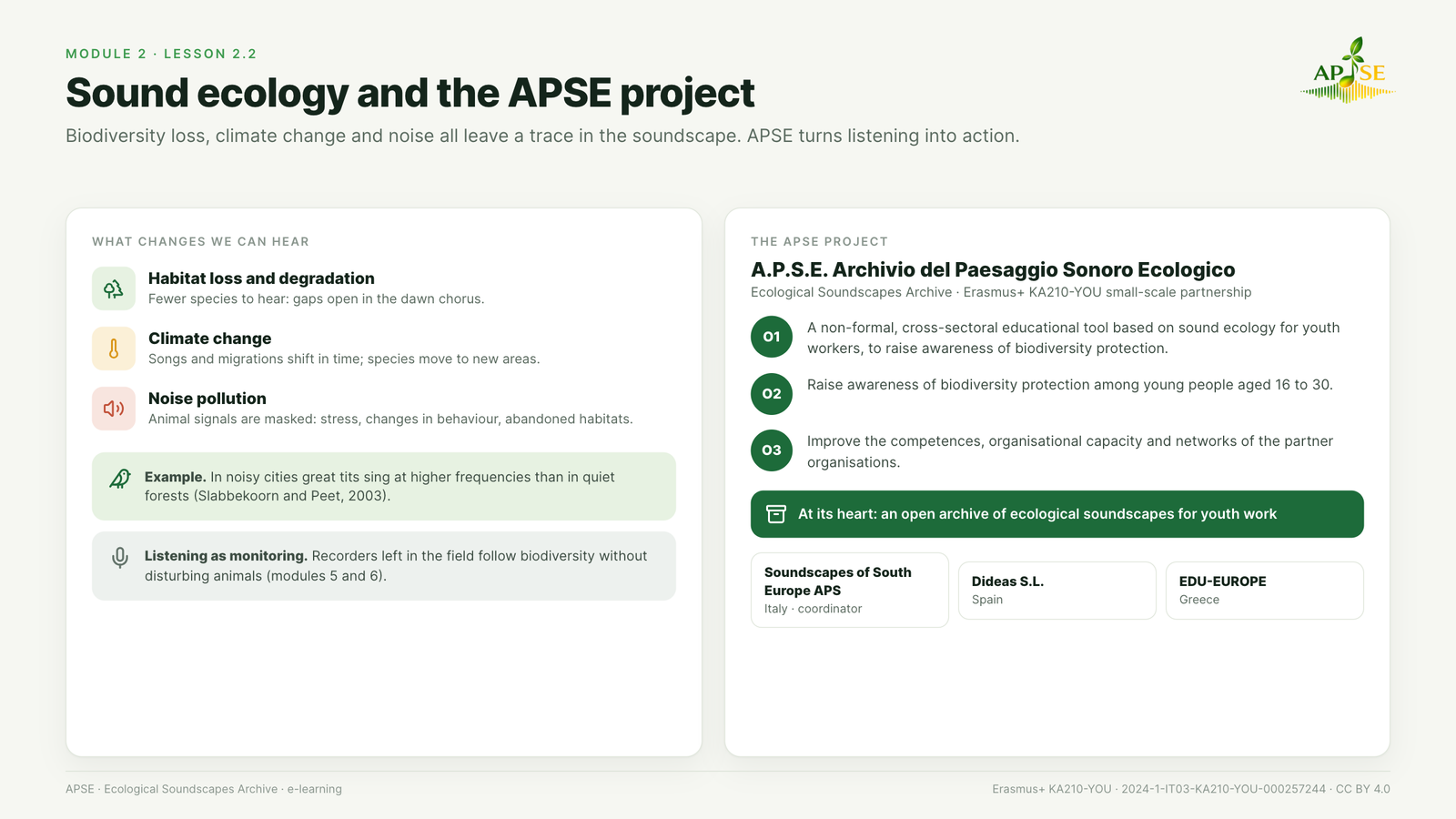
Figure 2.2. Sound ecology and the APSE project. What leaves a trace in the soundscape, and the three objectives of APSE.
Sound ecology studies the relationships between sounds, living organisms and their environment. Soundscape ecology, as defined by Pijanowski and colleagues (2011), looks at all the sounds of a landscape (biological, geophysical and human) and at how they change in space and time, as indicators of ecological processes.
Why it matters today. Biodiversity loss, climate change and noise pollution all leave a trace in the soundscape:
- habitat loss and degradation reduce the number of species we can hear;
- climate change shifts the timing of songs and migrations and moves species to new areas;
- human noise masks animal signals and can cause stress, changes in behaviour and abandonment of habitats. In noisy cities, for example, great tits have been shown to sing at higher frequencies than in quiet forests (Slabbekoorn and Peet, 2003).
Listening as monitoring. Recording a place regularly makes it possible to follow changes in biodiversity without disturbing animals. This approach, called passive acoustic monitoring, uses recorders left in the field and is explored in modules 5 and 6.
Sound ecology in education. Sound is an accessible, emotional and creative entry point to complex topics such as biodiversity and climate change. Listening, recording and creating with sounds turns abstract data into direct experience, which is why sound ecology is well suited to non-formal education with young people.
The APSE project. A.P.S.E., “Archivio del Paesaggio Sonoro Ecologico” (Ecological Soundscapes Archive), is an Erasmus+ KA210-YOU small-scale partnership coordinated by Soundscapes of South Europe APS (Italy) with Dideas S.L. (Spain) and Κοιν.Σ.ΕΠ. EDU-EUROPE (Greece). Its objectives are:
- O1: provide youth workers, through sound ecology, with a non-formal and cross-sectoral educational tool to raise awareness of biodiversity protection;
- O2: raise awareness of biodiversity protection among young people aged 16 to 30;
- O3: improve the competences, organisational capacity and networks of the partner organisations.
At the heart of the project is an open archive of ecological soundscapes that youth workers and young people can explore, enrich and use in educational activities. Modules 3 and 4 explain why such an archive matters.
Watch: Soundscape Ecology, with Bryan Pijanowski (American Institute of Biological Sciences, YouTube). Third-party video embedded from YouTube; it is not covered by the course licence (CC BY 4.0).


Funded by the European Union. Views and opinions expressed are however those of the author(s) only and do not necessarily reflect those of the European Union or the Agenzia Italiana per la Gioventù. Neither the European Union nor the granting authority can be held responsible for them.
APSE · Erasmus+ KA210-YOU · 2024-1-IT03-KA210-YOU-000257244 · Licence CC BY 4.0 · Free and open: no registration needed.
