
Open Course › Course 1 › Module 3 · The soundscape archive
Module 3 · The soundscape archive
Thematic module 2: Importance of the Soundscape Archive
Module goals. By the end of this module you will be able to:
- explain what a soundscape archive is and what information it must contain;
- describe its benefits for research, education and awareness;
- explain how an archive helps us understand the local acoustic environment.
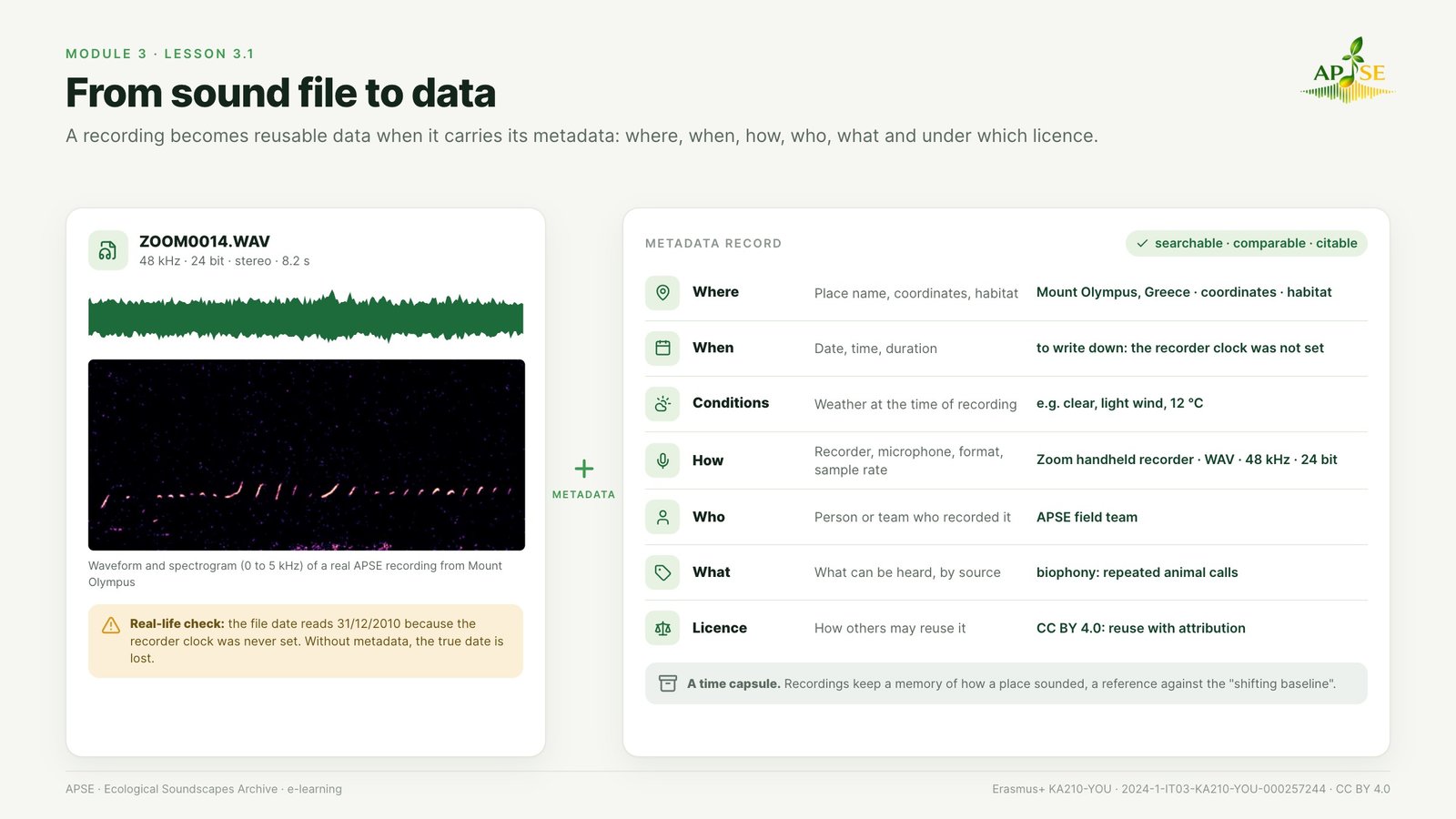
Figure 3.1. From sound file to data. A real APSE recording becomes reusable data when it carries its metadata.
A soundscape archive is an organised collection of environmental recordings, each accompanied by the information needed to understand and reuse it. A recording on its own is just a sound file; a recording with where, when, how and what becomes data that can be listened to, compared and studied for years.
Essential information (metadata) for every recording:
- place: name, coordinates, habitat;
- date and time, duration;
- weather conditions;
- equipment and settings (recorder, microphone, format, sample rate);
- who recorded it;
- a description of what can be heard (main species, sources of noise, biophony, geophony, anthropophony);
- the licence that says how others may use it.
Sound archives around the world. Large collections such as the British Library Sound Archive, the Macaulay Library of the Cornell Lab of Ornithology and the community platform xeno-canto show how recordings gathered over decades become a shared heritage for science, education and culture.
A recording is a time capsule. Soundscapes change: species disappear or arrive, roads are built, seasons shift. Without recordings of the past we risk taking today’s poorer soundscape as “normal” (the shifting baseline). An archive keeps a memory of how a place sounded and gives a reference for future comparisons.
Watch: Macaulay Library HD (Macaulay Library, Cornell Lab of Ornithology, YouTube). Third-party video embedded from YouTube; it is not covered by the course licence (CC BY 4.0).


Funded by the European Union. Views and opinions expressed are however those of the author(s) only and do not necessarily reflect those of the European Union or the Agenzia Italiana per la Gioventù. Neither the European Union nor the granting authority can be held responsible for them.
APSE · Erasmus+ KA210-YOU · 2024-1-IT03-KA210-YOU-000257244 · Licence CC BY 4.0 · Free and open: no registration needed.
