
Open Course › Course 2 › Module 8 · Evaluation and monitoring of APSE
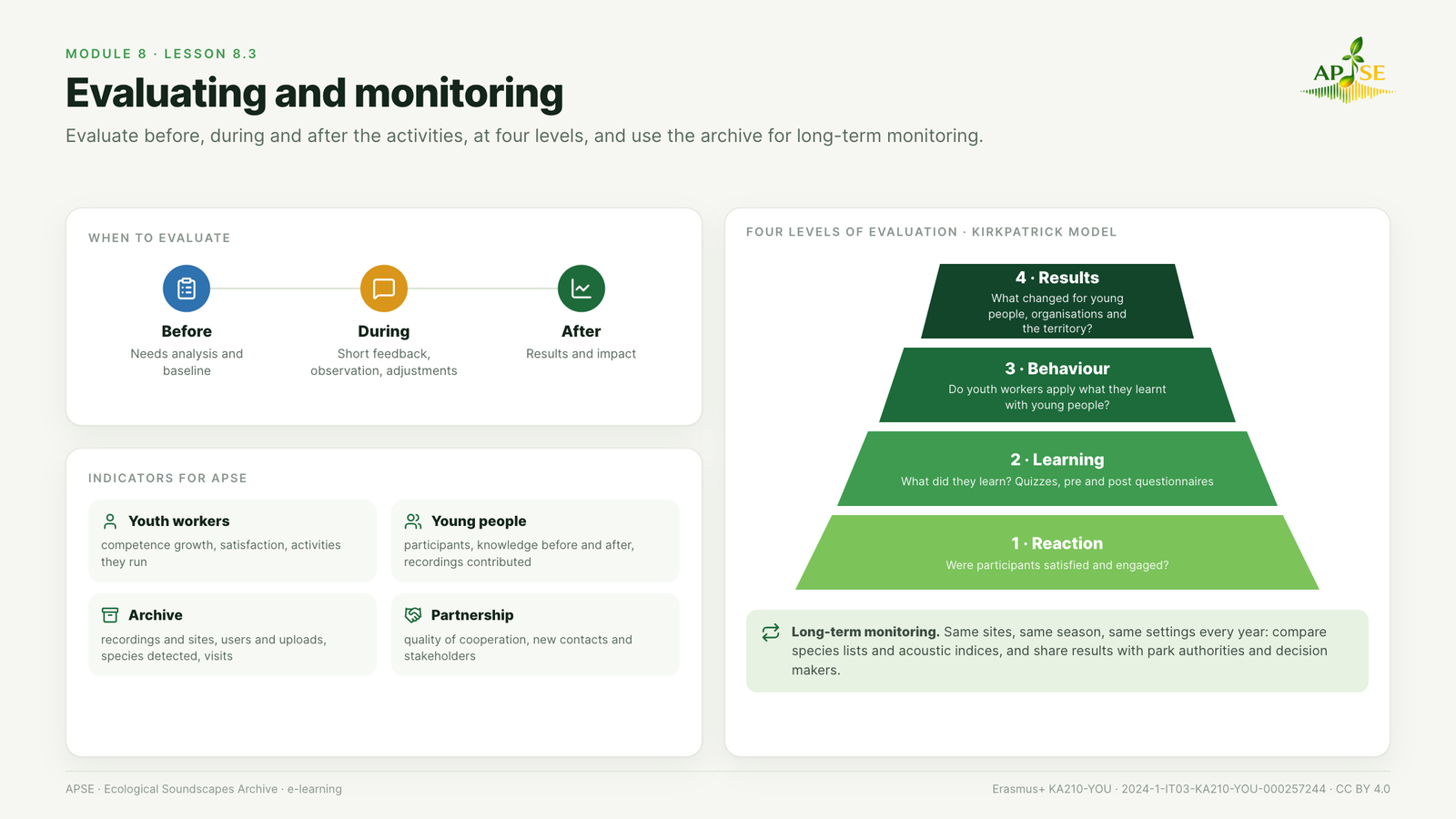
Figure 8.3. Evaluating and monitoring. Evaluation before, during and after activities, and the four levels of the Kirkpatrick model.
Evaluate before, during and after.
- Before: needs analysis and baseline (what participants know and expect).
- During: short feedback, observation, adjustments to the programme.
- After: results and impact.
Four levels of evaluation (Kirkpatrick model):
- Reaction: were participants satisfied and engaged?
- Learning: what did they learn? (quizzes, pre and post questionnaires)
- Behaviour: do youth workers apply what they learnt in their work with young people?
- Results: what changed for young people, for the organisations and for the territory?
Indicators for APSE.
- Youth workers: competence growth (ex ante and ex post), satisfaction, number of activities they run.
- Young people: number of participants, knowledge before and after, recordings contributed.
- Archive: number and quality of recordings and sites, registered users and uploads, species detected, visits.
- Partnership: quality of cooperation, new contacts and stakeholders.
Tools. Online questionnaires before and after, quizzes, observation grids, reflection diaries, focus groups, platform statistics. Questionnaires should be anonymous or comply with the GDPR.
Long-term monitoring with the archive. The archive becomes a monitoring tool when recordings are repeated in the same sites, in the same season and with the same settings. Comparing species lists and acoustic indices over the years shows whether biodiversity is stable, declining or recovering, and whether conservation measures work. Sharing these results with park authorities and decision makers turns listening into action.
After the project. Clear responsibilities for maintenance, open licences and an active community of youth workers keep the archive alive and useful.
Watch: The Kirkpatrick Model of Training Evaluation (Devlin Peck, YouTube). Third-party video embedded from YouTube; it is not covered by the course licence (CC BY 4.0).


Funded by the European Union. Views and opinions expressed are however those of the author(s) only and do not necessarily reflect those of the European Union or the Agenzia Italiana per la Gioventù. Neither the European Union nor the granting authority can be held responsible for them.
APSE · Erasmus+ KA210-YOU · 2024-1-IT03-KA210-YOU-000257244 · Licence CC BY 4.0 · Free and open: no registration needed.
