
Open Course › Course 1 › Module 2 · Sound ecology, biodiversity and APSE
Module 2 · Sound ecology, biodiversity and APSE
Thematic module 1: Introduction to Sound Ecology and APSE
Module goals. By the end of this module you will be able to:
- distinguish biophony, geophony and anthropophony;
- explain what sound ecology is and why it matters for biodiversity conservation;
- describe the aims of the APSE project.
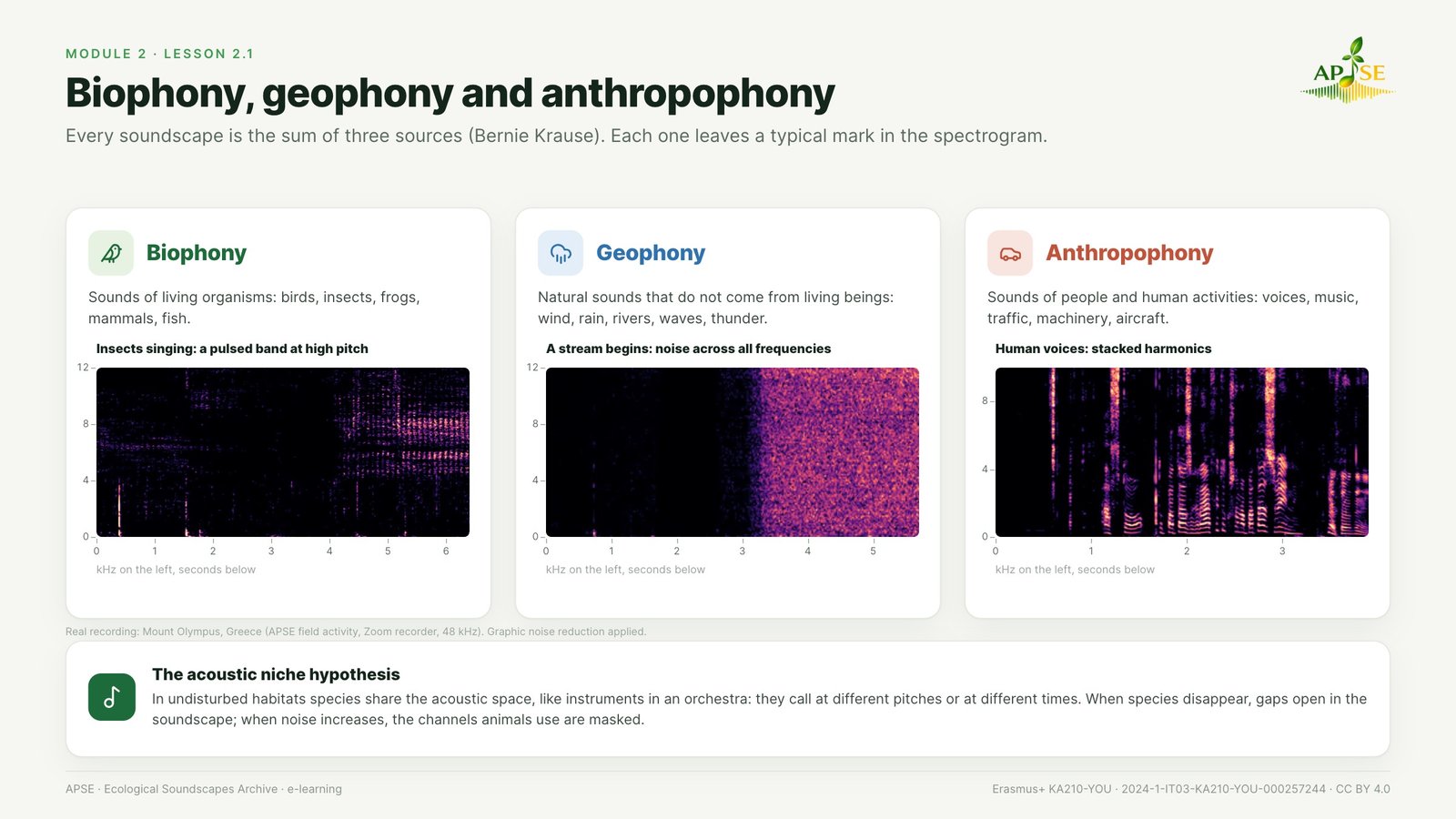
Figure 2.1. Biophony, geophony and anthropophony. Real spectrograms from Mount Olympus: insects, a stream and human voices.
Soundscape researchers describe every soundscape as the sum of three sources, terms introduced by Bernie Krause and later used in soundscape ecology:
- Biophony: sounds produced by living organisms, such as birdsong, insect calls, frog choruses, mammal vocalisations and fish sounds.
- Geophony: natural sounds that do not come from living beings, such as wind, rain, rivers, waves and thunder.
- Anthropophony: sounds produced by people and human activities, such as voices, music, traffic, machinery and aircraft. Some researchers also use technophony for the sounds of electrical and mechanical devices.
The acoustic niche hypothesis. Krause observed that in undisturbed habitats animals tend to share the acoustic space: different species call at different frequencies or at different times, like instruments in an orchestra, so that their signals do not overlap. A rich and well-organised biophony is therefore a sign of a healthy and diverse community. When species disappear, “gaps” appear in the soundscape; when noise increases, the channels used by animals are masked.
Rhythms in time. Soundscapes change during the day and across the seasons. The dawn and dusk choruses, the night calls of insects and amphibians, and the songs linked to the breeding season follow the biological clock of each species (phenology). Listening at different times of day and year shows how a place lives.
Try it with a group. During a soundwalk, ask participants to sort what they hear into three columns: biophony, geophony and anthropophony. Which column is the longest? How would the lists change at night or in another season?
Watch: Bernie Krause: The voice of the natural world (TED, YouTube). Third-party video embedded from YouTube; it is not covered by the course licence (CC BY 4.0).


Funded by the European Union. Views and opinions expressed are however those of the author(s) only and do not necessarily reflect those of the European Union or the Agenzia Italiana per la Gioventù. Neither the European Union nor the granting authority can be held responsible for them.
APSE · Erasmus+ KA210-YOU · 2024-1-IT03-KA210-YOU-000257244 · Licence CC BY 4.0 · Free and open: no registration needed.
