
Open Course › Course 2 › Module 6 · Organising, cataloguing and analysing sound data
Module 6 · Organising, cataloguing and analysing sound data
Thematic module 3: Collecting and managing environmental sounds in the archive
Module goals. By the end of this module you will be able to:
- organise and catalogue audio files and their metadata in a shared cloud archive;
- read a spectrogram and recognise the main types of sound;
- explain what acoustic indices and automatic species identification can and cannot tell us.
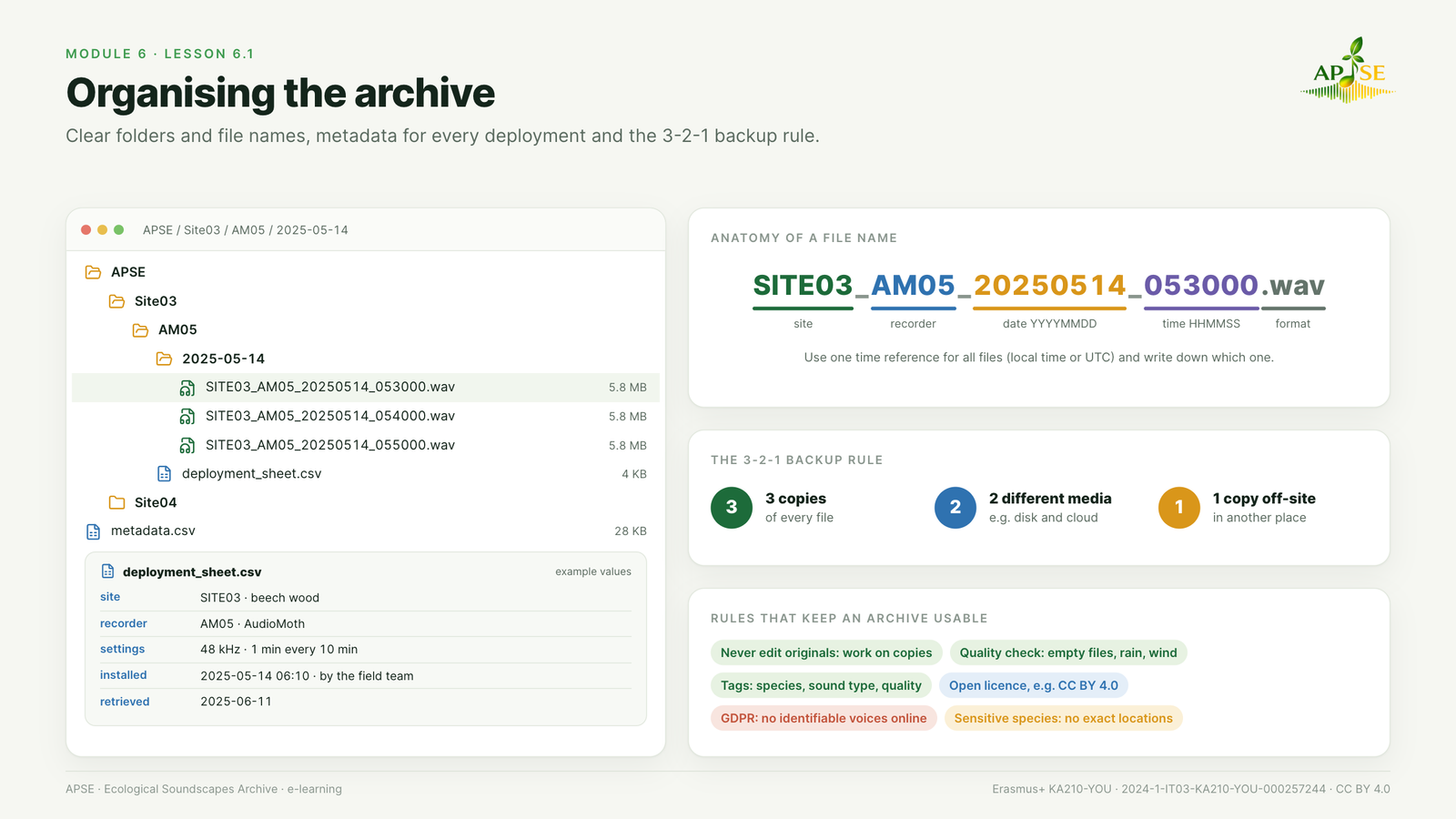
Figure 6.1. Organising the archive. A clear folder structure and file names, and the 3-2-1 backup rule.
A single autonomous recorder can produce tens of gigabytes of files in a month. Without clear rules, recordings quickly become impossible to find and to compare.
Folder structure and file names.
- Organise files by project, site, recorder and date (for example: APSE / Site03 / AM05 / 2025-05-14).
- Use clear, consistent file names, such as SITE_RECORDER_YYYYMMDD_HHMMSS.wav.
- Never edit the original files: keep them as they are and work on copies.
- Use the same time reference for all files (local time or UTC) and write down which one.
Metadata. Every deployment needs a sheet (site, coordinates, habitat, recorder ID, settings, dates of installation and retrieval, who installed it); every recording inherits these data and adds its own (date, time, duration, weather, what can be heard). Keep metadata in a spreadsheet or database with fixed field names.
Cloud storage. Uploading files to a shared cloud server allows all partners to access the same data, protects it from loss and makes automatic processing possible. Follow the 3-2-1 rule: three copies of the data, on two different media, one of them in another place.
Quality check. Listen to samples from each deployment, check for empty or damaged files, and mark periods with strong rain or wind.
Cataloguing. Add tags to each recording: species heard, sound types (biophony, geophony, anthropophony), quality, notes. Tags make it possible to search the archive.
Licences and privacy. Choose an open licence (for example CC BY 4.0) so that others can reuse the recordings. Recordings in which people can be identified by their voice contain personal data protected by the GDPR: remove those parts or do not publish them. For sensitive species (for example nesting raptors), do not publish exact locations.
Watch: Data Backup: The 3-2-1 Rule (ExplainingComputers, YouTube). Third-party video embedded from YouTube; it is not covered by the course licence (CC BY 4.0).


Funded by the European Union. Views and opinions expressed are however those of the author(s) only and do not necessarily reflect those of the European Union or the Agenzia Italiana per la Gioventù. Neither the European Union nor the granting authority can be held responsible for them.
APSE · Erasmus+ KA210-YOU · 2024-1-IT03-KA210-YOU-000257244 · Licence CC BY 4.0 · Free and open: no registration needed.
