
Open Course › Course 2 › Module 6 · Organising, cataloguing and analysing sound data
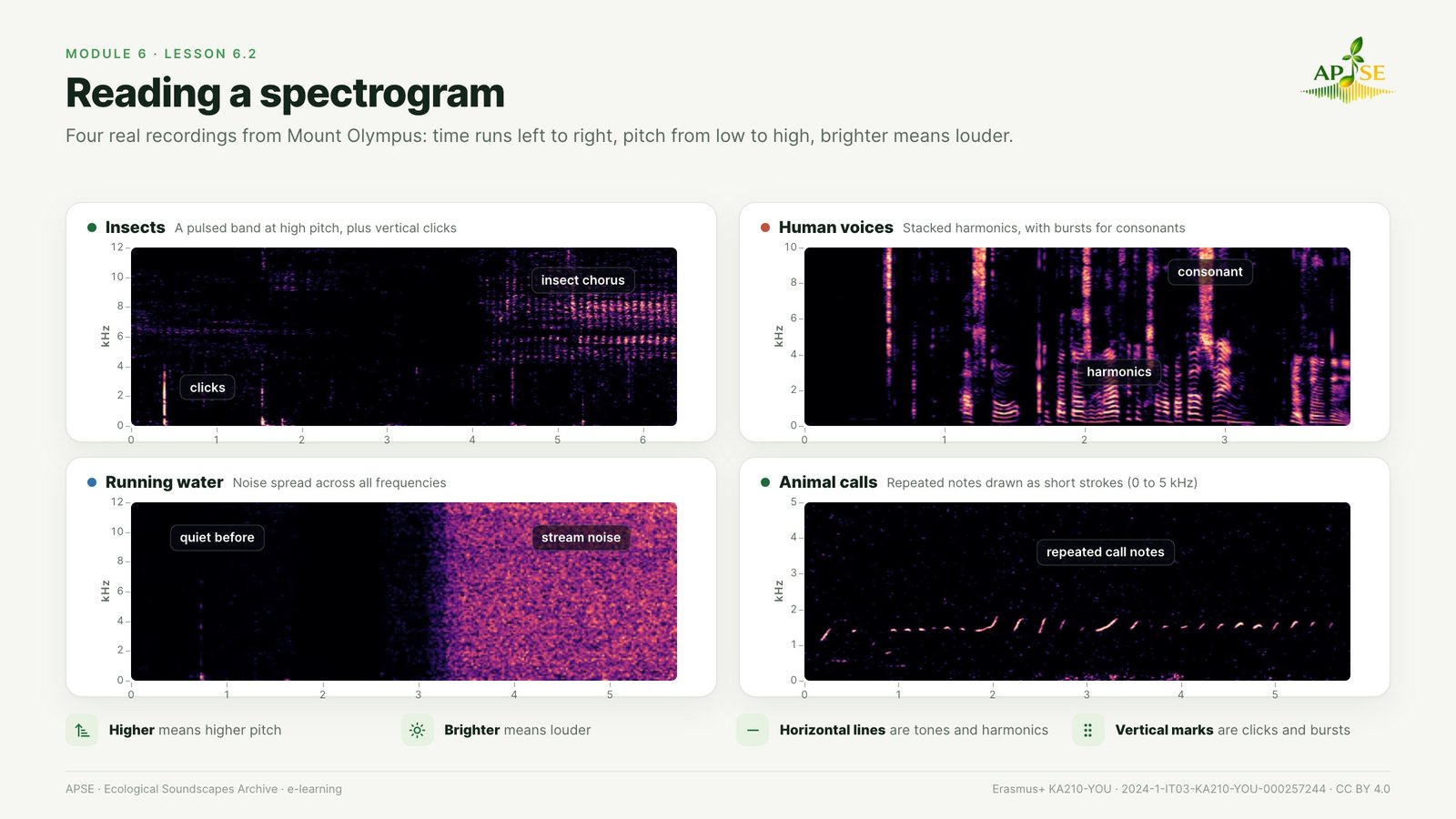
Figure 6.2. Reading a spectrogram. Four real recordings from Mount Olympus: insects, human voices, running water and animal calls.
A spectrogram is a picture of sound: time runs from left to right, frequency from bottom (low) to top (high), and colour or brightness shows intensity. It lets us “see” what we hear and find sounds in long recordings.
What sounds look like.
- Birdsong: notes, whistles and trills drawn as lines, curves and repeated shapes, usually between 1 and 8 kHz.
- Insects such as crickets and cicadas: long, regular bands or pulses, often at high frequencies.
- Frogs and toads: series of repeated pulses.
- Wind: strong energy at low frequencies, irregular in time.
- Rain: many short vertical marks across a wide frequency range.
- Traffic and engines: a continuous band at low frequencies, mostly below 2 kHz.
- Human voices: stacks of parallel lines (harmonics), mostly below 4 kHz.
Free software. Audacity (spectrogram view), Raven Lite (Cornell Lab of Ornithology) and Sonic Visualiser let you view spectrograms, select sounds and add labels.
Annotating. Select a sound and write down start and end time, frequency range, source and category (biophony, geophony, anthropophony). Annotations turn a recording into data.
Try it with a group. Show a spectrogram without sound and ask participants to guess what each shape is. Then play the recording and check the answers.
Watch: Bird Song Hero: The song learning game for everyone (Cornell Lab of Ornithology, YouTube). Third-party video embedded from YouTube; it is not covered by the course licence (CC BY 4.0).


Funded by the European Union. Views and opinions expressed are however those of the author(s) only and do not necessarily reflect those of the European Union or the Agenzia Italiana per la Gioventù. Neither the European Union nor the granting authority can be held responsible for them.
APSE · Erasmus+ KA210-YOU · 2024-1-IT03-KA210-YOU-000257244 · Licence CC BY 4.0 · Free and open: no registration needed.
