
Open Course › Course 2 › Module 6 · Organising, cataloguing and analysing sound data
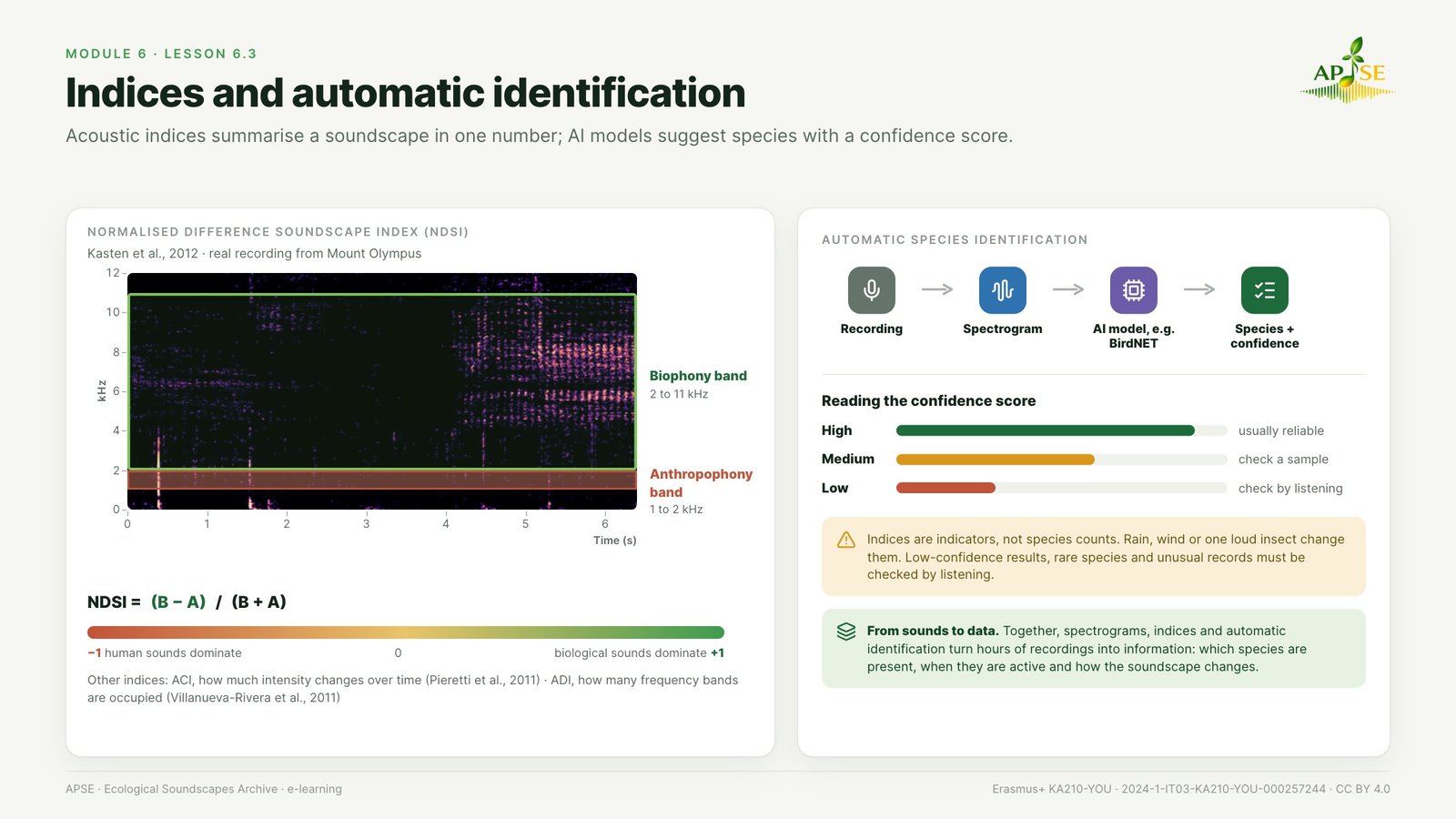
Figure 6.3. Indices and automatic identification. The NDSI bands on a real spectrogram, and how to read confidence scores.
Acoustic indices summarise a property of a soundscape in one number. They are useful for comparing many hours of recordings across sites and times.
- Acoustic Complexity Index, ACI (Pieretti et al., 2011): measures how much intensity changes over time within frequency bands. Birdsong and other biophony raise it; constant noise, such as a steady engine, affects it less.
- Acoustic Diversity Index, ADI (Villanueva-Rivera et al., 2011): measures how many frequency bands are occupied by sound and how evenly. Higher values suggest a more diverse soundscape.
- Normalised Difference Soundscape Index, NDSI (Kasten et al., 2012): compares biophony (2 to 11 kHz) with anthropophony (1 to 2 kHz). It ranges from minus 1 (human sounds dominate) to plus 1 (biological sounds dominate).
Use indices with care. Indices are indicators, not species counts. Rain, wind or a single loud insect can change their values. Compare recordings made with the same equipment and settings, and always check indices by listening and by looking at spectrograms.
Automatic species identification. Machine learning models are trained on large libraries of recordings labelled by experts (such as xeno-canto and the Macaulay Library) and learn to recognise species from their spectrograms. BirdNET (Kahl et al., 2021), for example, recognises thousands of bird species. Each detection comes with a confidence score: results with low confidence, rare species and unusual records must be checked by listening.
From sounds to data. Spectrograms, indices and automatic identification together turn hours of recordings into information on which species are present, when they are active and how the soundscape changes.
Watch: Acoustic Complexity Index: A Simple Overview (with examples) (Tristan Louth-Robins, YouTube). Third-party video embedded from YouTube; it is not covered by the course licence (CC BY 4.0).


Funded by the European Union. Views and opinions expressed are however those of the author(s) only and do not necessarily reflect those of the European Union or the Agenzia Italiana per la Gioventù. Neither the European Union nor the granting authority can be held responsible for them.
APSE · Erasmus+ KA210-YOU · 2024-1-IT03-KA210-YOU-000257244 · Licence CC BY 4.0 · Free and open: no registration needed.
