
Open Course › Course 1 › Module 1 · Sound and soundscapes
Module 1 · Sound and soundscapes
Thematic module 1: Introduction to Sound Ecology and APSE
Module goals. By the end of this module you will be able to:
- explain what sound is and describe its main properties;
- define a soundscape and recognise its main elements;
- use active listening as a starting point for sound ecology activities.
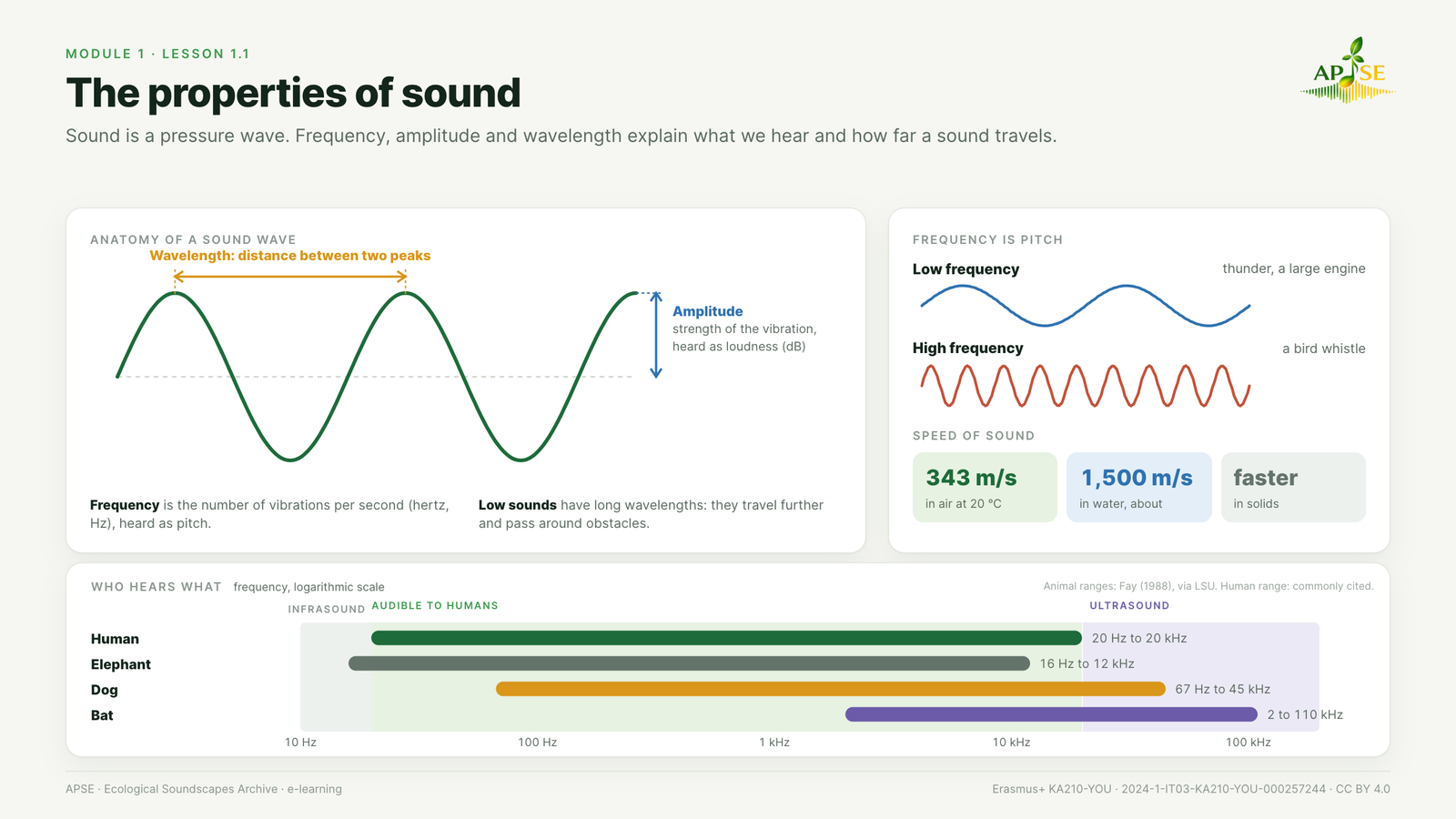
Figure 1.1. The properties of sound. Wavelength, amplitude and frequency, and the hearing ranges of people and animals.
Sound is a vibration that travels through a medium, such as air, water or the ground, as a wave of pressure. A source (a bird’s syrinx, a cricket’s wings, the wind in the leaves, an engine) makes the particles of the medium vibrate; the vibration passes from particle to particle until it reaches an ear or a microphone. Without a medium there is no sound: in a vacuum sound cannot travel.
Speed. Sound travels at about 343 m/s in air at 20 °C, at about 1,500 m/s in water and even faster in solids. This is why whales can communicate across very long distances in the ocean.
Frequency. Frequency is the number of vibrations per second, measured in hertz (Hz). We perceive it as pitch: high frequencies sound high (a bird’s whistle), low frequencies sound low (thunder). Humans hear roughly from 20 Hz to 20,000 Hz (20 kHz). Many animals use sounds we cannot hear: elephants and whales use infrasound (below 20 Hz), bats and many insects use ultrasound (above 20 kHz).
Amplitude. Amplitude is the strength of the vibration. We perceive it as loudness and measure it in decibels (dB). The decibel scale is logarithmic: an increase of 10 dB means ten times more sound intensity and is perceived as roughly twice as loud.
Wavelength. Wavelength is the distance between two peaks of the wave. It depends on frequency and on the speed of sound in the medium: low sounds have long wavelengths, travel further and pass around obstacles more easily. This is one reason why many animals that communicate over long distances use low frequencies.
Hearing and listening. Hearing is automatic; listening is a conscious act that gives meaning to sounds. Sound ecology starts with active listening: paying attention to what we hear, where it comes from and what it tells us about a place.
Try it with a group. Ask participants to close their eyes for one minute and count every sound they hear. Then compare the lists: who heard the most sounds? Which sounds did nobody notice at first?
Watch: Sound Properties (Amplitude, Period, Frequency, Wavelength) (Khan Academy, YouTube). Third-party video embedded from YouTube; it is not covered by the course licence (CC BY 4.0).


Funded by the European Union. Views and opinions expressed are however those of the author(s) only and do not necessarily reflect those of the European Union or the Agenzia Italiana per la Gioventù. Neither the European Union nor the granting authority can be held responsible for them.
APSE · Erasmus+ KA210-YOU · 2024-1-IT03-KA210-YOU-000257244 · Licence CC BY 4.0 · Free and open: no registration needed.
