
Open Course › Course 1 › Module 1 · Sound and soundscapes
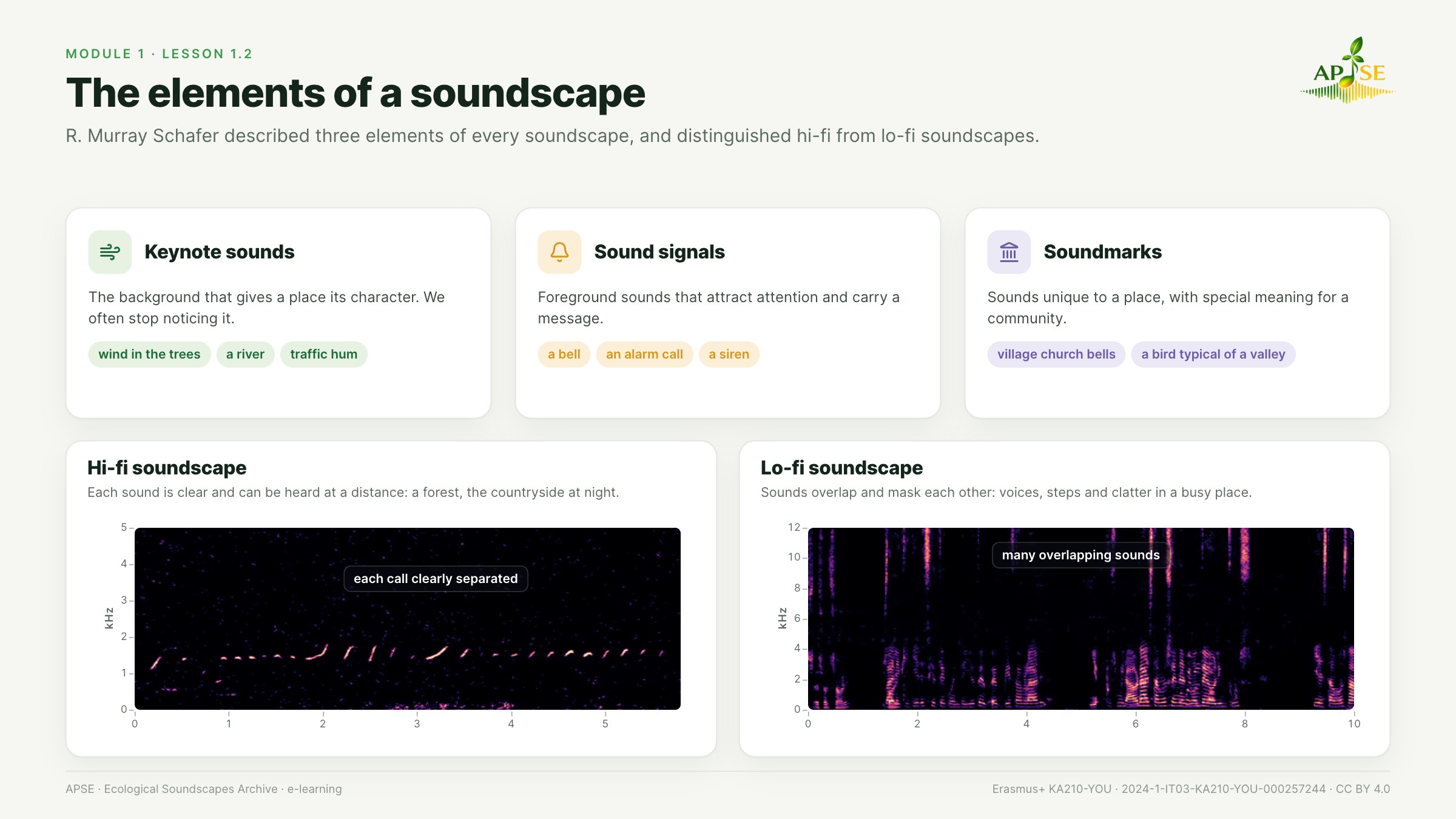
Figure 1.2. The elements of a soundscape. Schafer’s keynotes, sound signals and soundmarks, and real spectrograms of a hi-fi and a lo-fi soundscape.
A soundscape is the acoustic environment of a place as it is perceived, experienced or understood by people in context (ISO 12913-1). Every place, natural or urban, has its own sonic identity, and the soundscape is inseparable from the landscape.
The concept was developed by the Canadian composer R. Murray Schafer and the World Soundscape Project at Simon Fraser University, which from the late 1960s and 1970s recorded, studied and documented soundscapes as cultural and ecological resources. In The Tuning of the World (1977) Schafer proposed three key elements:
- Keynote sounds: the background sounds that define the character of a place and that we often stop noticing, such as wind in the trees, a river or the hum of traffic.
- Sound signals: foreground sounds that attract attention and carry a message, such as a bell, an alarm call or a siren.
- Soundmarks: sounds that are unique to a place and have special meaning for a community, such as the bells of a village church or the call of a bird typical of a valley.
Schafer also distinguished hi-fi soundscapes, where individual sounds are clear and can be heard at a distance (a forest, the countryside at night), from lo-fi soundscapes, where sounds overlap and are masked by continuous noise (a busy city).
Perception is subjective. The same sound can be a keynote for a local resident, a soundmark for a visitor who links it to a memory, and a signal when it rings unexpectedly. Barry Truax described sound as a mediator between people and their environment: understanding how others listen helps us respect different cultures and experiences.
The soundwalk. A soundwalk is a walk in which participants listen in silence to the sounds around them. Developed by Hildegard Westerkamp and the World Soundscape Project, it is one of the simplest and most effective tools to start working with soundscapes in non-formal education.
Watch: R. Murray Schafer: Listen (documentary) (National Film Board of Canada, YouTube). Third-party video embedded from YouTube; it is not covered by the course licence (CC BY 4.0).


Funded by the European Union. Views and opinions expressed are however those of the author(s) only and do not necessarily reflect those of the European Union or the Agenzia Italiana per la Gioventù. Neither the European Union nor the granting authority can be held responsible for them.
APSE · Erasmus+ KA210-YOU · 2024-1-IT03-KA210-YOU-000257244 · Licence CC BY 4.0 · Free and open: no registration needed.
